
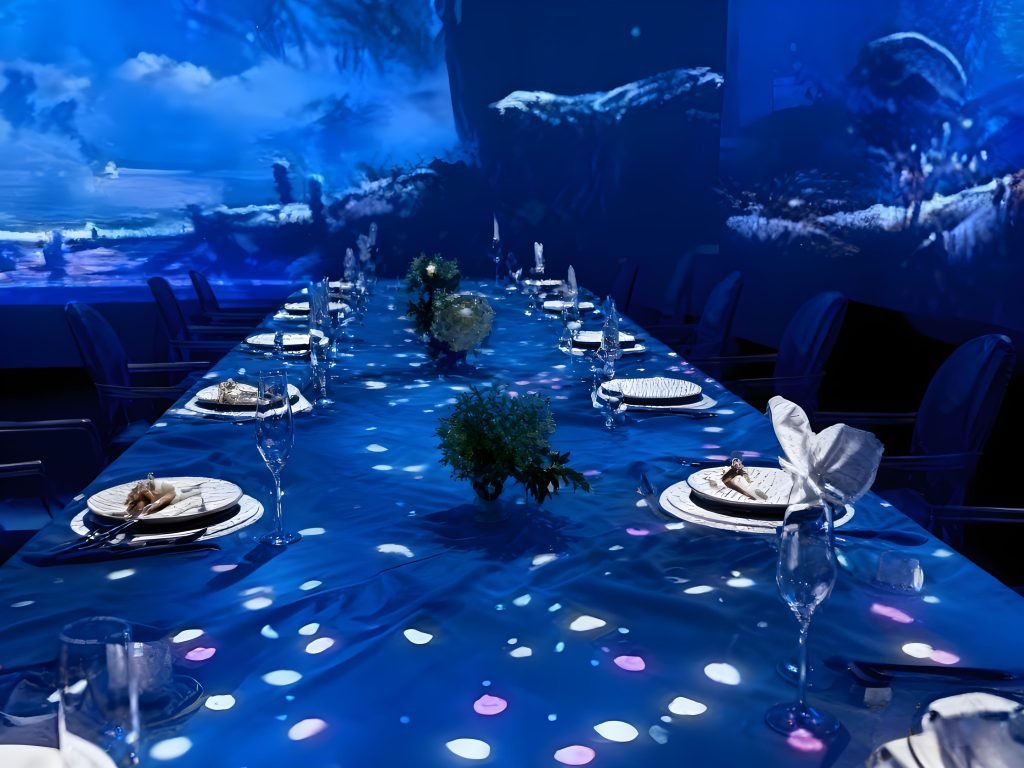
Imagine reaching out to touch a school of swimming fish at your table, looking up to admire a dazzling starry sky, and glancing down to find a floor blooming with flowers—this isn’t a scene from a sci-fi movie, but the real experience offered by an immersive projection restaurant.
When the magic of technology blends into the dining space, a meal becomes more than just a taste sensation. While traditional restaurants are becoming increasingly homogenized in their competition over dishes, service, and decor, immersive projection dining uses holographic projection, interactive sensors, and AI technology to create a multi-dimensional immersive dining environment for consumers.

Comprehensive Comparison: Traditional Restaurant vs. Immersive Projection Restaurant
| Aspect | Traditional Restaurant | Immersive Projection Restaurant |
|---|---|---|
| Ambiance | Static decor, difficult to change | Dynamic scenes, switchable with one click between themes like starry sky, ocean, forest |
| Interactive Experience | Minimal or limited interaction | Customers can interact in real-time with projections via gestures and movements |
| Cost of Scene Changes | High renovation cost, long cycle | Digital content updates cost only 1/10 of traditional methods |
| Potential for Higher Spending | Relies solely on the food itself | Experience-based premium can reach 30% or even higher |
| Technology Application | Limited or none | Integrates cutting-edge tech like holographic projection, AI interaction, sensing technology |
| Marketing Effect | Relies on traditional channels | Surge in social media sharing, creating organic word-of-mouth |
Core Technologies Creating Immersive Experiences
The震撼 experience of immersive projection restaurants is built on several key technologies:
- Dynamic Holographic Projection: Utilizes high-precision optical engines and real-time rendering to achieve naked-eye 3D visual effects with resolutions up to 8K. Projection covers walls, floors, tables, and even ceilings, creating a fully encompassing visual environment.
- Intelligent Interactive System: Depth-sensing cameras and sensors capture user movements, allowing interaction with virtual elements—waving to switch scenes, moving cutlery to trigger effects, or tapping a finger to make flowers bloom.
- Multi-Sensory Integration Technology: Combines visual, auditory, tactile, and even olfactory elements for a truly immersive atmosphere. For instance, an ocean scene is accompanied by wave sounds and a subtle sea breeze scent, completely transforming the traditional dining experience.
Diverse Application Scenarios
The flexibility of immersive projection dining makes it suitable for various commercial scenarios:
Themed Events & Holiday Celebrations
During Valentine’s Day, a “Starry Wishing Room” can be created: tabletops simulate a vast galaxy, customers draw heart patterns with gestures, and the system generates personalized starry posters. Such events can increase store traffic by 45% and significantly boost social media exposure.
Cultural Experiences & Brand Storytelling
A high-end Cantonese restaurant used a “Historical Scroll” projection system to display dynamic Lingnan ink paintings on walls, with each dish linked to details and explanations of ancient artwork. Customers can scan QR codes for dish origin stories, making culinary culture tangible. This increased average spending by 30% while enriching the brand’s cultural depth.
Corporate Events & Private Customization
Immersive projection restaurants are suitable not only for weddings, banquets, and corporate annual dinners but also for product launches. By integrating sound, light, electricity, holographic projection, and audio systems, they create unique atmospheres tailored to specific events.
Empowerment through AI & Big Data
When combined with AI and big data, the potential of immersive projection dining expands significantly:
Intelligent Operations Management
AI inventory forecasting systems integrate multi-dimensional data like historical sales, weather, holidays, and promotions to accurately predict future business trends. Practical tests show prediction errors can be below 4%, reducing procurement decision time by over 80% and significantly lowering raw material waste.
Personalized Interactive Experiences
AI can customize exclusive “themed murder mystery” dining flows based on customers’ social media data. Using facial recognition and customer profiling, the system can automatically adjust projection content and recommend preferred scene themes upon arrival.
Data-Driven Decision Making
Built-in smart recognition modules record data like customer dwell time and interactive hotspot areas, helping optimize layout design and projection content. A Japanese restaurant found through data analysis that table turnover in projection areas was 15% slower, leading them to adjust lighting intensity and projection frequency, improving operational efficiency without compromising experience.
Market Prospects & Development Trends
Immersive projection dining is in a phase of rapid growth with promising future prospects:
- Market Size: China’s themed restaurant industry is expected to exceed ¥200 billion by 2025, with a CAGR of 12%. Immersive experiences, as a key segment, are attracting increasing investor attention.
- Technology Integration: In the future, AR/VR technology penetration in themed restaurants may exceed 50%, with metaverse restaurant virtual orders potentially surpassing 30%. AI dish recommendation systems could cover 90% of leading brands, increasing average spending by 12-18%.
- Sustainable Development: Green and sustainable themes are emerging trends, including “zero-waste restaurants” and “carbon-neutral themed banquets”. 70% of consumers are willing to pay a premium for “green certification”.
Conclusion
Immersive projection dining represents more than a visual upgrade—it’s a fundamental shift in culinary philosophy. This innovative approach transforms ordinary meals into rich, multi-dimensional journeys where technology seamlessly blends with art and culture.
For guests, the experience delivers a feast for all senses, moving far beyond traditional dining. Every meal becomes an opportunity for discovery and wonder, creating lasting memories through stunning visual storytelling.
Restaurateurs benefit from a powerful competitive advantage. This technology provides a clear path to stronger profitability while establishing a unique market position that sets venues apart.
On an industry-wide level, these experiences demonstrate how to successfully merge cutting-edge innovation with timeless culinary traditions. They offer a compelling vision for hospitality’s future direction.
In today’s experience-driven economy, these establishments have evolved beyond mere hunger solutions. They’ve become destinations for creating cherished memories, sharing joyful moments, and witnessing technology’s transformative potential. This isn’t a distant future concept—it’s the exciting reality of dining’s ongoing evolution.
Leave a Reply