
When an ordinary tabletop can identify any object you place on it and instantly display corresponding digital content—this is the magic-like experience brought by the Object Recognition Table.
1.In a children’s education center, a teacher places a picture book about animals on the table, and the surface immediately transforms into a three-dimensional African savanna, with zebras from the book running across it.
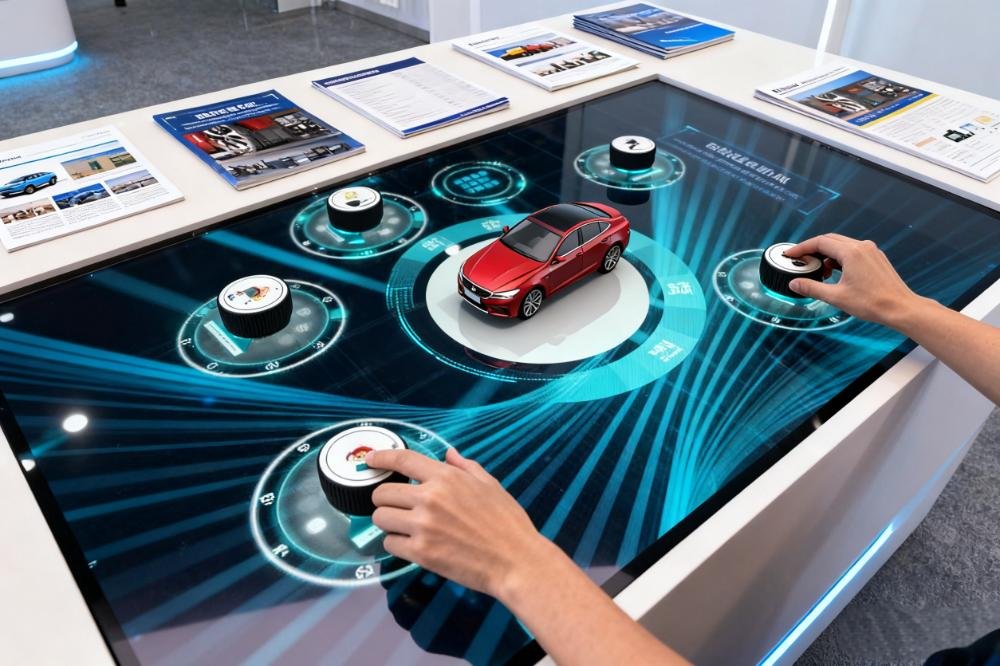
2. In a corporate showroom, an engineer places a mechanical component on the table, and it instantly displays a 3D model and internal structure of the part.
3.In a restaurant, a customer pushes an empty coffee cup to the center of the table, and the system automatically places an order and generates personalized dessert recommendations.
This is the Object Recognition Table—a revolutionary interactive multimedia product that seamlessly blends physical object recognition with digital interaction.
Why is the Object Recognition Table Revolutionary?
Core Technical Advantages
- High-Precision Object Recognition: Utilizes deep learning algorithms to support simultaneous recognition of multiple objects with an accuracy rate of up to 98%.
- Millisecond-Level Response Speed: From object placement to content display, latency is controlled within 0.3 seconds.
- Multi-Modal Interaction: Supports seamless switching between touch, gestures, and physical object manipulation.
Comparison with Traditional Interactive Methods
| Feature | Traditional Touchscreen | Object Recognition Table |
|---|---|---|
| Interaction Method | Touch-only | Physical objects + touch + gestures |
| Learning Curve | Requires learning | Intuitive operation |
| Immersiveness | 2D planar experience | 3D stereoscopic interaction |
| Scalability | Limited | Unlimited (via new object recognition) |
| Target Audience | Primarily adults | All age groups |
Diverse Application Scenarios
Education: Making Learning Tangible
In a science class at an international school, students place different mineral specimens on the table, which instantly displays the formation process, molecular structure, and practical applications of each mineral. Proven results show this method increases knowledge retention by 45%.
Commercial Displays: Revolutionizing Product Experience
In an automotive showroom, customers simply place different car models on the table to see 3D disassembly diagrams, performance parameters, and customization options. This interaction triples customer dwell time and increases sales conversion by 25%.
Retail Innovation: Immersive Shopping Experience
At high-end cosmetics counters, the Object Recognition Table allows customers to place product samples and instantly view ingredient analysis, usage tutorials, and customer reviews. This experiential marketing approach boosts sales of individual items by 60%.
Dining & Entertainment: New Smart Ordering Experience
In smart restaurants, customers place specific menu card combinations, and the table displays the dish’s origin story, nutritional information, and recommended pairings. This interaction increases average spending per customer by 30% and achieves 95% customer satisfaction.
Core Elements of Technical Implementation
Hardware Configuration
- Ultra-high resolution infrared camera arrays
- Customized microlens structured light system
- Nanoscale touch sensing layer
- 4K ultra-high definition display module
Software Algorithms
text
Object recognition process:
Physical placement → Feature extraction → Algorithm matching → Content retrieval → Real-time rendering
Using Convolutional Neural Networks (CNN) for object feature learning, combined with point cloud analysis technology, ensures recognition accuracy remains above 95% even in low-light environments.
Deep Integration with AI and Big Data
Personalized Experiences
The system records user interaction behaviors and uses machine learning algorithms to analyze preferences, automatically adjusting content recommendation strategies. Data shows that AI-optimized content delivery increases user interaction time by 50%.
Operational Optimization
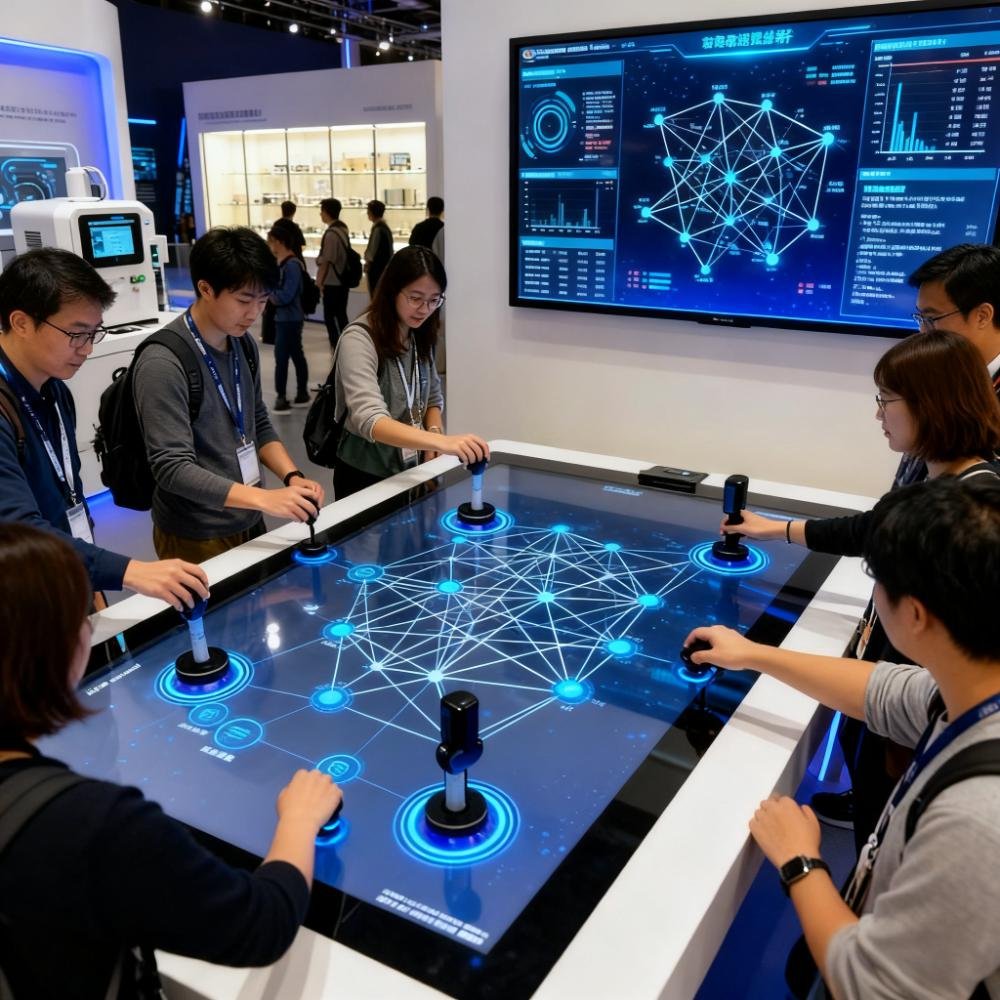
The backend management system analyzes heat maps of recognition areas in real-time, helping operators understand user interest points and optimize content strategies. One science museum tripled the recognition rate of its most popular exhibits through data analysis.
Intelligent Prediction
Based on historical interaction data, the system can predict users’ next likely actions and pre-load relevant resources, improving interaction response speed by 40%.
Future Development Trends
Technological Evolution
- Recognition accuracy will improve from 98% to 99.9%
- Recognizable object categories will expand from thousands to millions
- Response speed will be optimized to within 0.1 seconds
Application Expansion
By 2025, object recognition technology will penetrate these fields:
- Smart healthcare: Surgical instrument recognition and guidance
- Industrial manufacturing: Part identification and assembly guidance
- Home entertainment: Smart home control centers
Ecosystem Development
The Object Recognition Table will evolve into an open platform supporting third-party developers in creating recognition content, forming a complete ecosystem. The related market size is expected to reach ¥20 billion by 2026.
Implementation Recommendations
Suitable Deployment Scenarios
- Science centers, museums, planning exhibitions
- Brand experience centers, flagship stores
- Smart classrooms, training centers
- High-end restaurants, hotels
ROI Analysis
Example for a medium-sized science center:
- Initial investment: ¥500,000-800,000 (including hardware and content)
- Annual maintenance: Approximately ¥50,000
- Expected benefits: 30% increase in visitor traffic, 40% longer dwell time
- Payback period: 1.2 years
Conclusion
The Object Recognition Table is not merely a technological innovation but a revolution in human-computer interaction. It seamlessly connects the digital and physical worlds, creating unprecedented interactive experiences.
For educational institutions, it’s a magical platform that sparks learning interest; for commercial spaces, it’s an intelligent window that enhances experiences; for entertainment venues, it’s an interactive hub that creates joy.
In the wave of digital transformation, the Object Recognition Table represents an important direction: technology should serve people, enhance experiences, and create value. It is redefining how we interact with the digital world, and this future has already arrived.
Data in this article is based on industry case studies. Actual results may vary depending on specific implementation. Contact us for more details and customized solutions.
Leave a Reply