
While visuals and sounds construct virtual worlds, motion platforms hold the key to full-body immersive perception.
Have you ever experienced dizziness in VR when a sharp turn on screen conflicted with your stationary body? Or felt immediately disconnected when a virtual roller coaster’s plunge contrasted with your physical stability? This sensory inconsistency represents a major pain point in current VR experiences, and motion platforms are the crucial technology solving this problem.
Market Overview: Scale, Growth, and Regional Landscape
The motion platform market is experiencing rapid growth. According to market research data, the global VR motion platform market will maintain steady growth between 2020 and 2031, with the Asia-Pacific region, particularly China, showing significant expansion. From a global perspective, North America, Europe, China, and Japan represent the primary markets and manufacturing bases for motion platforms.
The motion platform industry categorizes systems by degrees of freedom, including 2-DOF, 3-DOF, and 6-DOF types, with applications spanning entertainment, defense, automotive, and numerous other fields. This technology is rapidly expanding from professional sectors to consumer markets.
The Core Value of Motion Platforms in VR: From Visual to Full-Body Immersion
The fundamental value of motion platforms in VR systems lies in their ability to bridge digital and physical worlds, using precise motion matching to deceive our brains into believing what we see is what we feel.
When a VR character runs on rough terrain, the motion platform creates corresponding vibrations; when a virtual roller coaster plunges downward, the platform tilts forward to simulate weightlessness; when a flight simulator rolls, the platform rotates synchronously. This multi-sensory synchronization is crucial for eliminating VR-induced dizziness and creating deep immersion.
Research indicates that when visual, vestibular, and somatosensory inputs align, participants’ immersion scores increase by 62%, while discomfort decreases by 45%. Motion platforms address VR’s most challenging issue—motion sickness—by providing inputs consistent with the vestibular system.
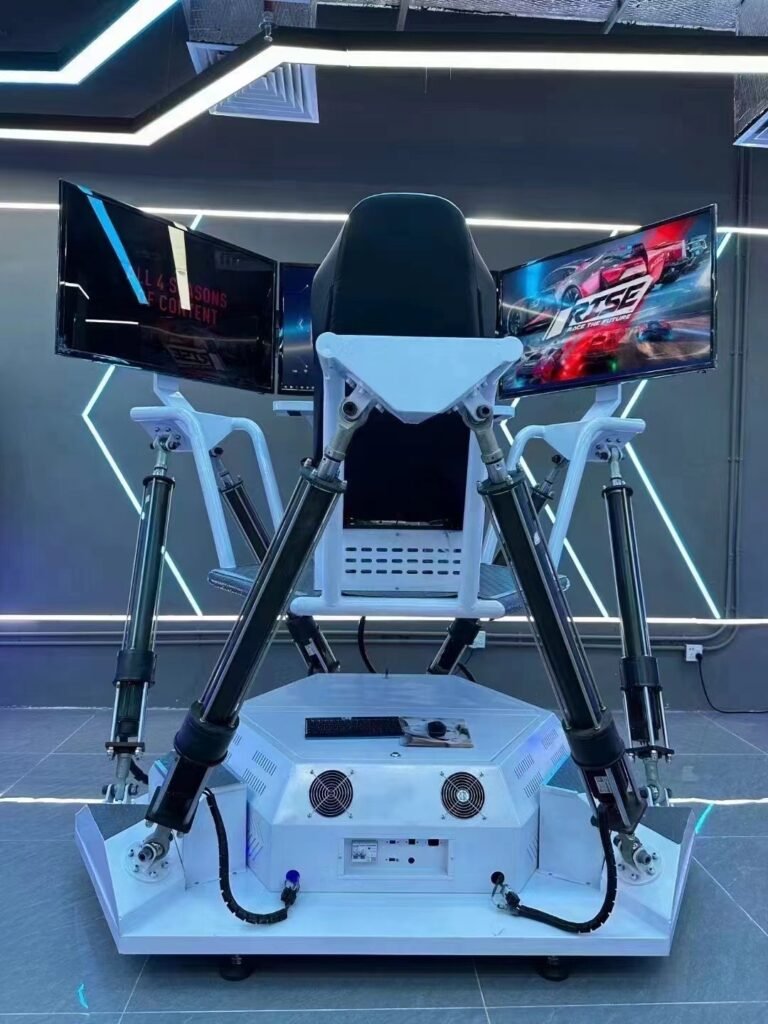
Technical Route Analysis: The Electric, Hydraulic, and Pneumatic Competition
The drive method forms the core of motion platform performance, with three main technical routes currently dominating: electric, hydraulic, and pneumatic systems.
Electric Platforms: Premium Choice for High-End Experiences
Electric platforms represent the high-end category, predominantly featuring 6-DOF designs with adjustable speeds, delivering the best performance among all motion platforms. They employ integrated servo motor and screw designs, converting the servo motor’s rotational motion into linear movement while transforming precise speed, rotation count, and torque control into accurate velocity, position, and thrust control.
Key Technical Advantages:
- High-precision positioning: Repeat positioning accuracy reaches ±0.01mm, far exceeding traditional hydraulic or pneumatic systems
- Clean and eco-friendly: No hydraulic oil or air medium required, eliminating leakage risks
- Excellent energy efficiency: Power converts directly from electrical to mechanical energy with high efficiency
- Simple maintenance: Primarily requires regular grease lubrication throughout the product’s lifespan
Performance Limitations:
- Cost considerations: Higher system hardware investment, particularly for high-thrust systems
- Force limitations: Maximum approximately 350kN, below hydraulic systems’ virtually unlimited capacity
Hydraulic Platforms: Balancing Performance and Cost
Hydraulic platforms represent the mid-range category, requiring higher technical specifications but offering moderate pricing, with 6-DOF simulation providing high realism and relatively smooth motion.
Key Technical Advantages:
- Smooth movement: Hydraulic oil compressibility provides natural cushioning for smoother operation
- High power density: Greater thrust capacity within the same volume
- Cost-effectiveness: More economical than electric systems for medium-to-large thrust applications
Performance Limitations:
- Potential leakage: Hydraulic oil leakage risk makes them unsuitable for clean environments
- Lower efficiency: Multiple energy conversions result in reduced efficiency
- Complex maintenance: Requires regular hydraulic oil and seal replacements
Pneumatic Platforms: Entry-Level Solutions
Pneumatic platforms represent the entry-level category, with the lowest technical requirements and most affordable pricing, typically featuring 3-DOF designs and providing the simplest effects.
Key Technical Advantages:
- Lowest cost: Simple system composition with minimal initial investment and maintenance
- High speed: Air compressibility enables extremely fast system response
- Clean operation: Leaks don’t cause contamination, suitable for food and medical environments
Performance Limitations:
- Poor precision: Air compressibility results in low positioning accuracy
- Limited force: Restricted output capacity due to air pressure limitations
- Unsteady movement: Prone to vibration and impact
Technical Comparison Overview
| Characteristic | Electric Platforms | Hydraulic Platforms | Pneumatic Platforms |
|---|---|---|---|
| Precision | ±0.01mm level | Medium | Low |
| Maximum Force | ~350kN | Virtually unlimited | Low |
| Maintenance Needs | Low | High | Medium |
| Cleanliness | High | Low (oil contamination risk) | Medium |
| Response Speed | High | Medium | High |
| Cost | High | Medium | Low |
Electric Cylinder Technical Details: MCEA vs. RCEA Structural Choices
Even within the electric platform category, different electric cylinder structures offer varying performance characteristics. The main types currently include MCEA sliding table structures and RCEA rod-type structures.
MCEA Sliding Table Characteristics:
- Load capacity: 15kg horizontal, 6kg vertical
- Maximum speed 330mm/s, acceleration 3300mm/s²
- Repeat positioning accuracy ±0.01mm
- Thrust range 50-200N
RCEA Rod Structure Characteristics:
- Load capacity: 8kg horizontal, 2kg vertical
- Maximum speed 300mm/s, acceleration 0.3G
- Repeat positioning accuracy 0.01mm
- Thrust range 30-200N
MCEA excels in scenarios requiring precise control with its high load capacity and precision, while RCEA’s rapid response and compact size make it superior for high-frequency motion applications.
Industry Development Trends: Integration, Intelligence, and Sustainability
The motion platform industry is evolving toward greater intelligence, integration, and sustainability.
Technology Integration Trends:
- Electrification replacement: High-force electric cylinders enable easier energy consumption and carbon accounting for pressing/clamping/forming stations
- Predictive maintenance: Sensor/condition monitoring packages combined with edge analysis/cloud platforms for lifespan management
- Unified networking: Integration with OPC UA/MQTT, TSN, vPLC for “control + data” unification
Sustainability Trends:
- Recycled plastics, bio-based materials replacing traditional materials to reduce carbon emissions
- Second-hand platforms, leasing services, and refurbishment becoming mainstream, driving green industry transformation
Market Growth Trends:
As pandemic conditions gradually stabilize, the virtual gaming industry and cultural tourism sector are experiencing explosive rebounds. Coupled with 5G-era integration of virtual reality, mixed reality, and augmented reality across various industries, new business formats and development models are emerging.
Core Metrics for Evaluating Motion VR Products
When selecting motion VR products, comprehensive assessment across multiple dimensions is essential to evaluate technical maturity and user experience.
Core Technical Indicators
- Synchronization and latency: End-to-end delay should be below 25ms, well below human perception thresholds
- Motion range and degrees of freedom: Support for 6DoF full-body tracking has become standard for high-end products
- Accuracy: Systems with external inertial measurement units (IMU) + laser positioning stations enable millimeter-level pose tracking
- Force and speed: Maximum thrust, speed, and acceleration parameters must match content requirements
User Experience Elements
- Immersion consistency: Perfect alignment between physical motion and visual content is crucial for eliminating dizziness
- Comfort and safety: Seat design, safety belt systems, and emergency stop functions are essential
- Content ecosystem: Even the best hardware is useless without quality content. A rich, high-quality content library is a vital evaluation metric
Commercial and Operational Considerations
- Throughput: Achieving theme-park-level throughput in compact spaces is a key consideration
- Operational costs: Electric cylinder systems, while requiring higher initial investment, have lower long-term maintenance costs
- Space requirements: Excellent motion platforms should simulate large-scale virtual environments within limited spaces
Future Outlook: Technical Pathways for Next-Generation Motion Platforms
Motion platform technology is advancing toward higher precision, lower latency, and stronger immersion. Several noteworthy technical trends include:
- Linear motor integration: Formation of new approaches combining linear motor-type electric cylinders + high-performance servos for ultra-high dynamic processes
- Standardization and modularization: Reducing system integration complexity to promote technology adoption
- AI optimization: Machine learning analysis of user motion data for personalized experiences
- Haptic feedback expansion: Evolving from simple motion platforms to comprehensive tactile sensations, including multi-dimensional feedback like temperature and wind
In the near future, we’ll likely see motion platforms transitioning from professional to consumer markets, eventually becoming part of home entertainment. As technology integration deepens, motion VR experiences will become more realistic, comfortable, and accessible.
Leave a Reply