
High-Tech Swing: How Golf Simulators Become Your Personal Coach
Imagine experiencing lush fairways, sand bunkers, and changing winds—all through a projection screen. Modern golf simulators bring this reality to life using advanced 3D imaging and measurement technologies. These systems create realistic course scenes and ball flight trajectories that help players improve their game regardless of weather or location.
Golf simulators let players use real clubs while instantly displaying each shot’s path through the air. This technology not only overcomes traditional limitations but has evolved into a professional training tool that efficiently builds skills through precise feedback.
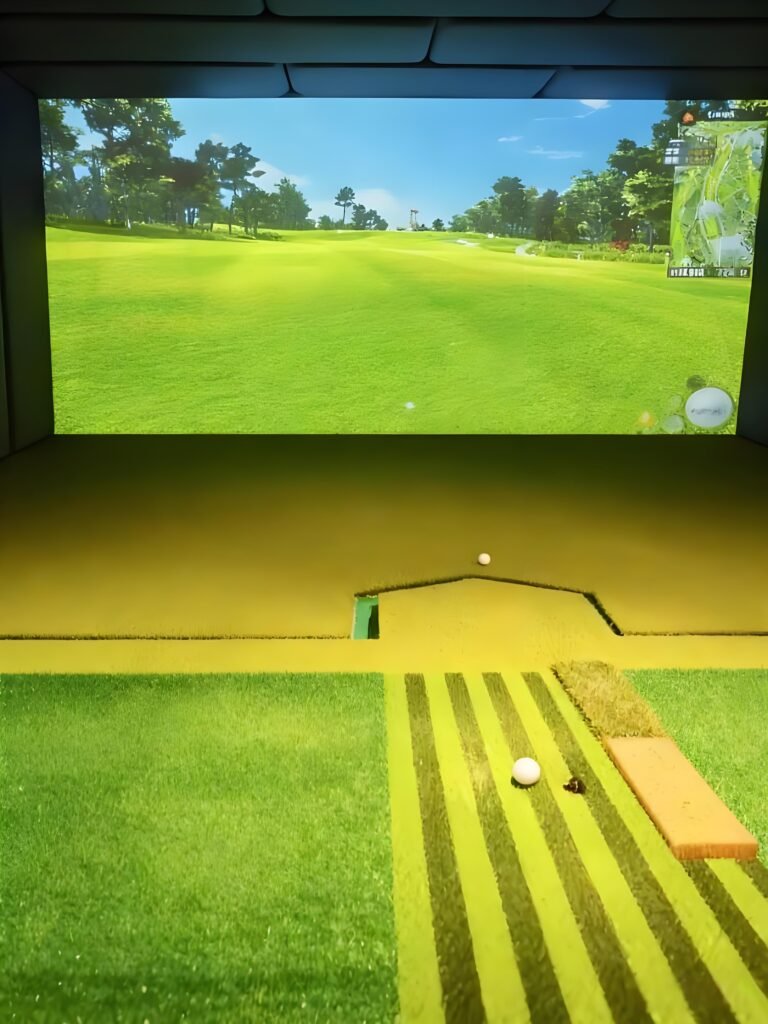
01 How Simulators Create Virtual Golf Reality
The technology behind golf simulators operates through two key components working in harmony.
Sensors and computer controllers first capture critical impact data. This system precisely measures the ball’s initial velocity, launch angle, deflection, and spin immediately after contact.
Meanwhile, a graphics processor and projector team up with an impact-resistant screen to create the visual experience. Together, they generate realistic 3D course environments and display the ball’s flight pattern.
When a player hits a ball, the system instantly analyzes its movement. The processor then calculates the trajectory and displays it on screen seamlessly. This creates a continuous, realistic experience that makes users feel they’re playing an actual course.
02 The Evolution of Swing Measurement Technology
Sensing technology has advanced significantly through four generations, each improving accuracy and user experience.
Early infrared sensors from the 1990s detected ball speed and direction using tripods or panels beside the hitting area. While cost-effective, their accuracy remained limited.
Next, radar sensors adapted from military technology focused on measuring clubhead data during swings. However, they struggled with low-speed putts and raised radiation concerns, leading to their gradual replacement.
High-speed cameras then revolutionized data collection by capturing ball movement at 2,000 frames per second. Today’s advanced 3D ultra-high-speed systems record swing dynamics and ball flight at thousands of frames per second. This military-grade technology adapted for civilian use delivers exceptional accuracy across all shot types.
03 Transforming Practice Through Data and Scenarios
Modern simulators turn training into a scientific process with clear visual feedback.
Precise Performance Metrics
Leading systems display landing points, stopping positions, and shot trajectories. Players immediately understand each shot’s results while accessing organized data points that highlight key improvement areas.
Swing Analysis Tools
These systems capture fundamental swing parameters like speed, angle, and rotation. Multi-angle replay functionality combines with clear clubhead data, making practice sessions more intuitive and productive.
Adaptive Training Modes
Driving range mode analyzes swings and creates target exercises that improve accuracy. Course mode meanwhile supports multiplayer competition with adjustable wind and green conditions, accommodating diverse training needs.
04 Expanding From Professional to Mainstream Use
Golf simulators now serve various environments from professional training to public entertainment.
Industry reports confirm global adoption across North America, Europe, and Asia with established service networks. Commercial installations in shopping centers regularly serve dozens of users daily per unit.
High-end models now include climate simulation, recreating challenging weather conditions like rain and strong winds. This provides comprehensive adaptive training opportunities beyond fair-weather practice.
As industry experts observe, “Display equipment has evolved from visual assistance to immersive experience driver.” This shift highlights the technology’s direction toward creating increasingly engaging user experiences.
05 Smarter, More Immersive Future Developments
Simulator technology continues advancing toward greater intelligence and immersion.
Technical experts emphasize that projection quality determines the overall experience. Only through detailed reproduction of turf texture, green slopes, and lighting can users enjoy truly realistic interaction.
New laser projection technology delivers high brightness and full HD quality with golf-specific color modes. These systems maintain clear visual detail even in bright environments, perfectly tracking the ball’s flight path.
Additionally, artificial intelligence integration enhances training effectiveness. Advanced AI systems capture and analyze personal swing data, offering customized recommendations that accelerate skill development.
Leave a Reply