
While visual and auditory immersion have reached new heights, the next frontier is dynamic physical immersion. The 360-degree rotating seat is the key that unlocks this door.
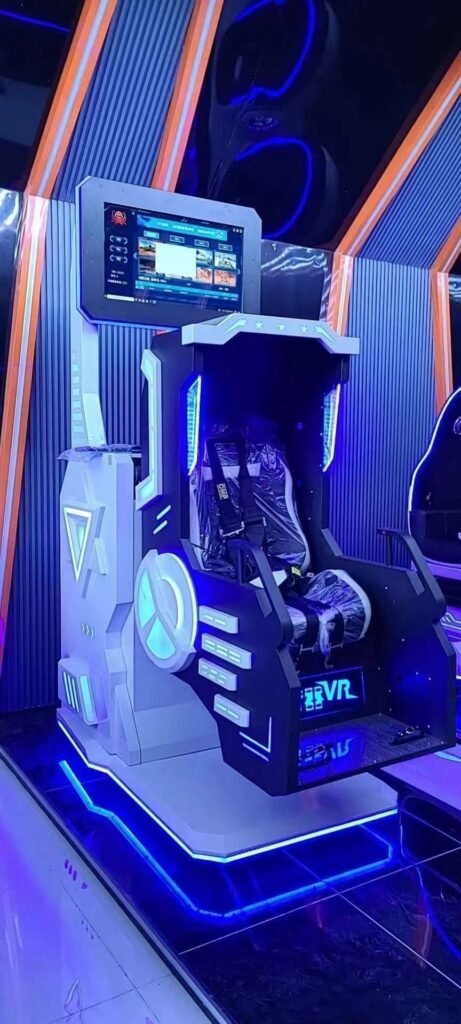
In the pursuit of ultimate immersion, 4K projections, surround sound, and VR headsets have conquered our eyes and ears. Yet, our bodies remain locked in static seats. The emergence of the 360-degree rotating seat shatters this final barrier. Through precise, fluid physical motion, it synchronizes the user’s entire body with the virtual world, elevating the experience from “watching” to “being there.”
01 Core Value: From Spectator to Participant
Compared to traditional fixed seating, the value of a 360-degree rotating seat lies in its delivery of unrestricted dynamic feedback.
- Enhanced Spatial Awareness: In flight simulators or racing games, the seat tilts and turns with the aircraft or vehicle, providing crucial gravitational cues and directional sense. This significantly reduces VR-induced motion sickness and heightens situational awareness.
- Increased Emotional Engagement: The fear and tension when a seat rumbles and spins as you’re “grabbed” from behind in a horror game is incomparable to a static experience. This synchronization of haptics and vision intensely amplifies emotional connection.
- Expanded Interaction Dimensions: It liberates the user’s orientation. In interactive projection games, players can naturally rotate their bodies to track and aim at targets from all directions, enabling more intuitive omnidirectional interaction without awkward neck craning or controller turning.
02 Applications: Possibilities Beyond Gaming
The technology’s adaptability makes it shine across numerous fields:
- Professional Simulation Training:
- Aviation & Aerospace: Provides highly realistic G-force simulation and attitude-change feedback for pilots and astronauts.
- Military & Defense: Used in tank and submarine simulators to train crew coordination and spatial orientation in complex environments.
- High-End Entertainment & Experience Centers:
- VR Theme Parks: Serves as the core for “dark ride” attractions, allowing guests to swoop and dive through fantastical worlds.
- Interactive Cinemas: Seat movements synchronize with plot twists, such as sharp turns during a chase scene or jolts from explosions.
- Interactive Projection Gaming Systems:
- Dynamic Shooters: Combined with projections on floors and walls, players seated in a rotating chair must quickly spin to engage enemies from 360 degrees, heavily testing reflexes and coordination.
- Virtual Tours & Exploration: “Fly” over the Grand Canyon or “walk” through ancient ruins, with the seat’s pitch and roll perfectly simulating the sensation of flight and ascent.
- Design & Engineering Review:
- Architects and engineers can “sit” inside their 3D models, performing immersive reviews from any angle to assess design details.
03 Technical Implementation: The Art of Smooth, Precise, and Safe Motion
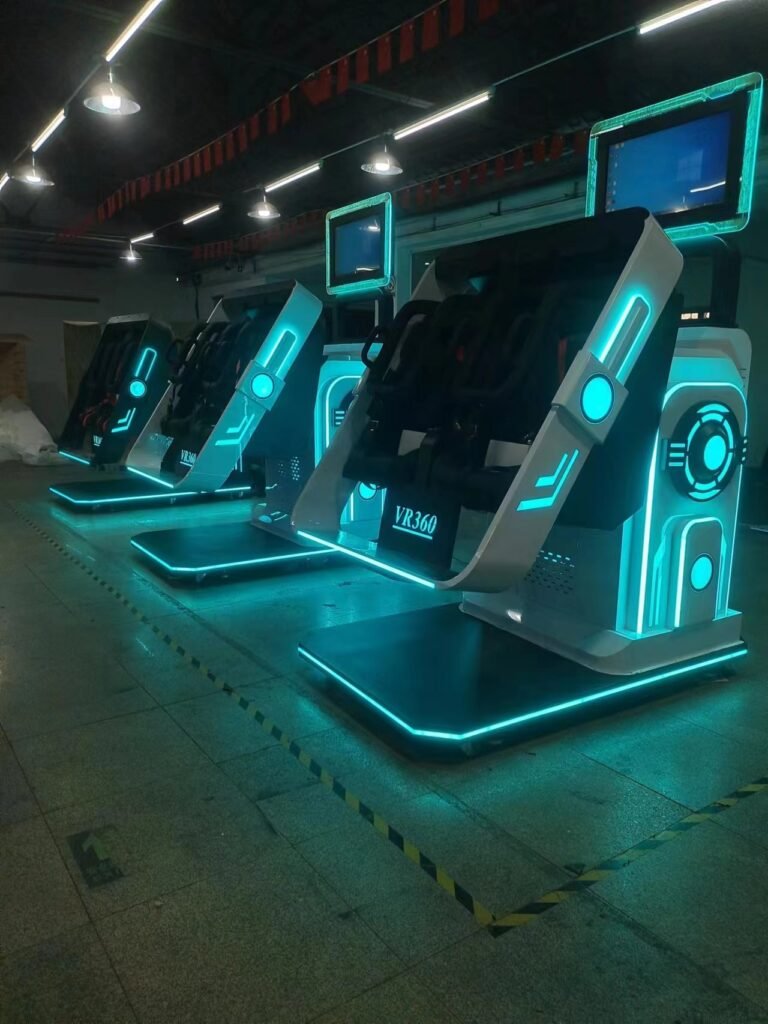
Creating an exceptional 360-degree rotating seat rests on three pillars:
- Power & Drive System:
- Typically employs high-torque servo motors to ensure powerful and smooth rotation.
- Paired with precision gear reducers for accurate speed and angle control, eliminating jerkiness.
- Control & Integration System:
- A central controller (like a PLC or advanced microcontroller) receives motion commands from the host PC running simulation software or a game engine.
- Through protocol integration (e.g., DMX, OSC, or custom APIs), it achieves frame-synchronization between the audiovisual content and seat motion, ensuring actions and visuals are perfectly synced.
- Safety & Structural Design:
- Dual safety with both mechanical and software limits to prevent over-rotation and cable winding.
- An emergency stop button is a mandatory safety feature, allowing the user to halt everything immediately if discomfort occurs.
- A robust steel frame and ergonomic seat design ensure safety and comfort during prolonged use.
04 The Future: The Ultimate Fusion of Haptic Feedback
Rotation alone is impressive, but it’s just the beginning. The future trend is the integration of Multi-Degree-of-Freedom (DOF) Motion Platforms with rotating seats.
- 2-DOF Platforms: Add front-to-back pitch to rotation, simulating acceleration, braking, and climbing.
- 3+ DOF Platforms: Further incorporate heave (up/down) and sway (left/right), capable of simulating complex motions like driving on rough terrain or a ship’s rocking.
When 360-degree rotation combines with multi-DOF motion, vibration, temperature control, and even wind effects, we come infinitely close to creating a “full-simulation environment” that can deceive all senses.
The 360-degree rotating seat is no longer a simple mechanical component; it is a dynamic bridge connecting the real and virtual worlds. By giving the body the most authentic language of motion, it allows us to experience digital adventures with our entire being. In the evolution of immersive experiences, it is undoubtedly a significant milestone.
Leave a Reply